
Your Content Is Good. So Why Is Nobody Watching It?
Most Creators Diagnose Poor Performance the Wrong Way
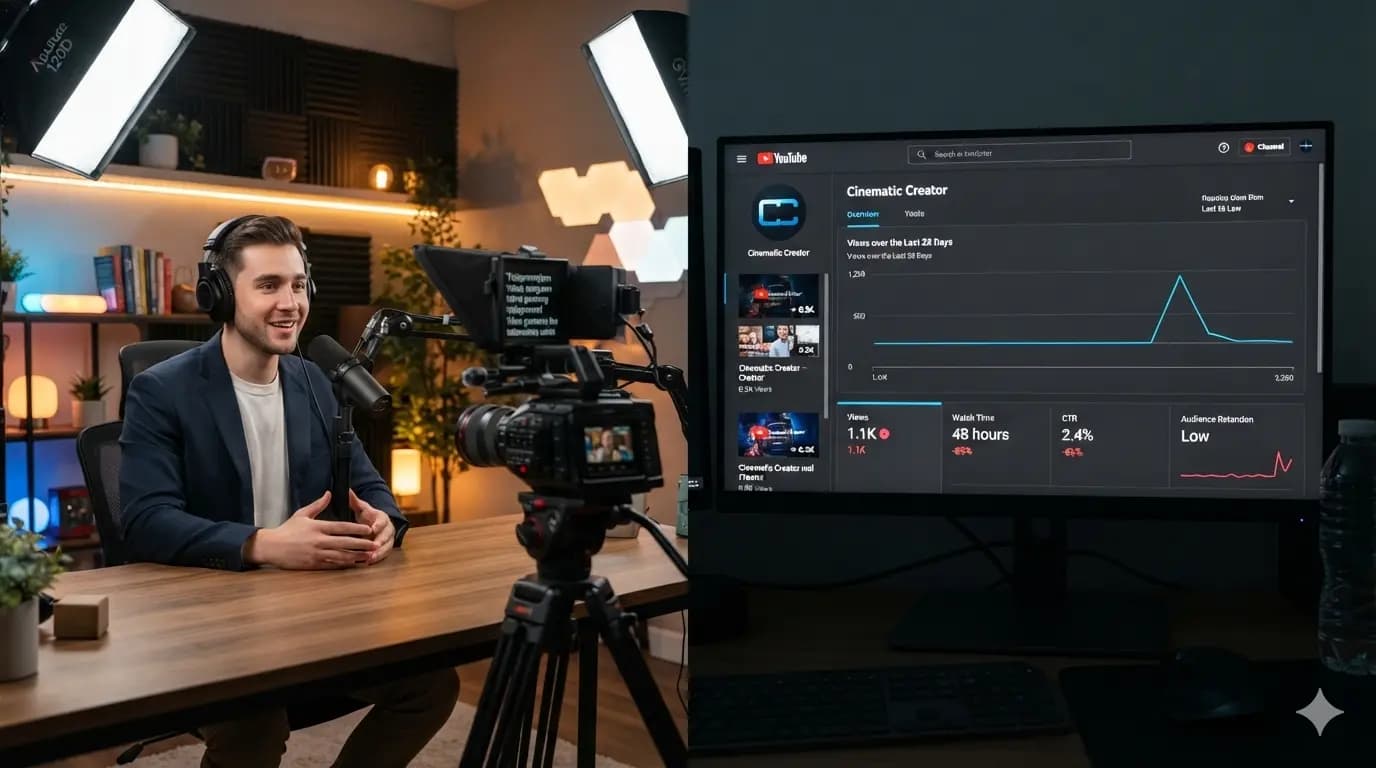
Most creators and brands diagnose poor performance in the same way: the content must not be good enough.
So they improve the camera, rewrite the script, add motion graphics, buy a better microphone, or spend more time editing. Yet the views remain low.
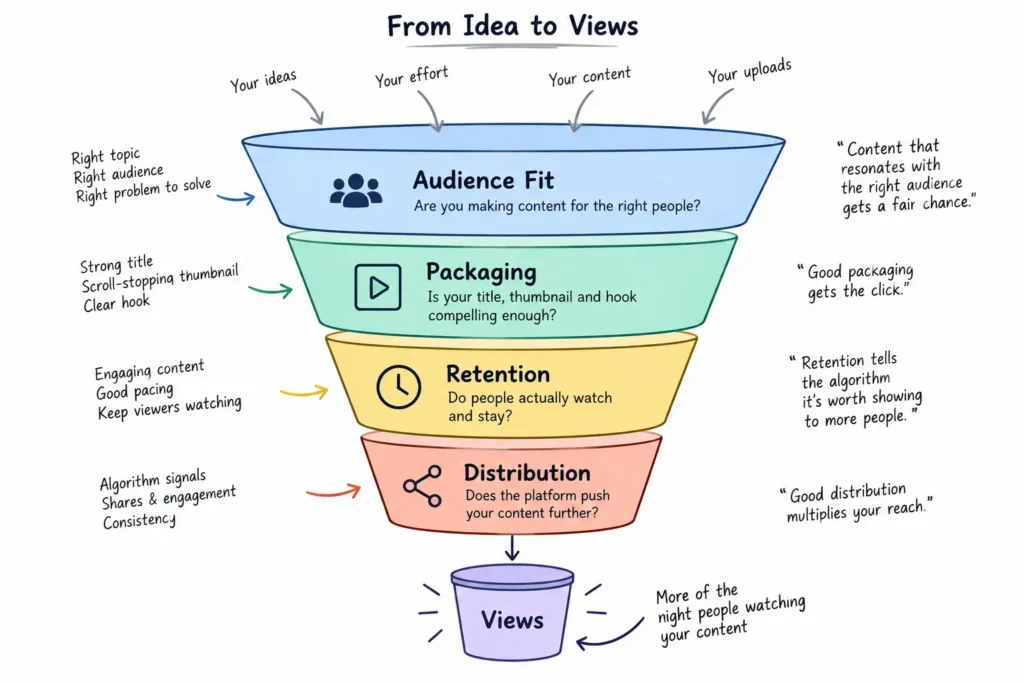
The uncomfortable truth is that good content can still fail. Not because quality is irrelevant, but because quality is only one part of the system. A video has to win several decisions before its quality can even be experienced. The right audience must see it. The packaging must make them stop. The opening must make them stay. The content must then deliver enough value to justify their attention.
If any one of these layers fails, the result looks the same on the dashboard: low views.
The First Mistake: Treating Views as a Verdict on Quality
Views measure consumption, not quality in isolation.
A thoughtful video may get ignored because its title is vague. A beautifully produced podcast may struggle because the guest is unfamiliar and the thumbnail gives viewers no reason to care. A useful reel may die because its first sentence takes seven seconds to reach the point.
Meanwhile, a simpler video may outperform all three because it makes a sharper promise.
This is why “the algorithm did not push it” is usually an incomplete diagnosis. Platforms respond to audience behaviour. If people do not click, stop, watch, or continue, distribution slows. The algorithm is not evaluating how hard the team worked. It is observing what viewers do.
The more useful question is not, “Why did the algorithm suppress us?” It is, “At which decision did we lose the viewer?”
Content Performance Has Four Layers
1. Audience Fit
The topic must matter to the people who currently receive the content.
Creators often confuse a subject they find interesting with a subject their audience is ready to consume. Brands make a similar mistake when they publish around internal priorities instead of customer problems.
Suppose a cybersecurity company publishes a detailed video about identity governance. The information may be excellent, but “identity governance” is a category, not necessarily a compelling entry point. A security leader may be more interested in a concrete consequence: thousands of AI agents accessing company systems without clear ownership.
The expertise remains the same. The framing changes from what the company wants to explain to what the audience urgently wants to understand.
2. Packaging
Before a viewer watches the content, they see its packaging: the topic, headline, thumbnail, caption, cover frame, or opening visual.
Packaging is not decoration added after production. It is the first stage of the product.
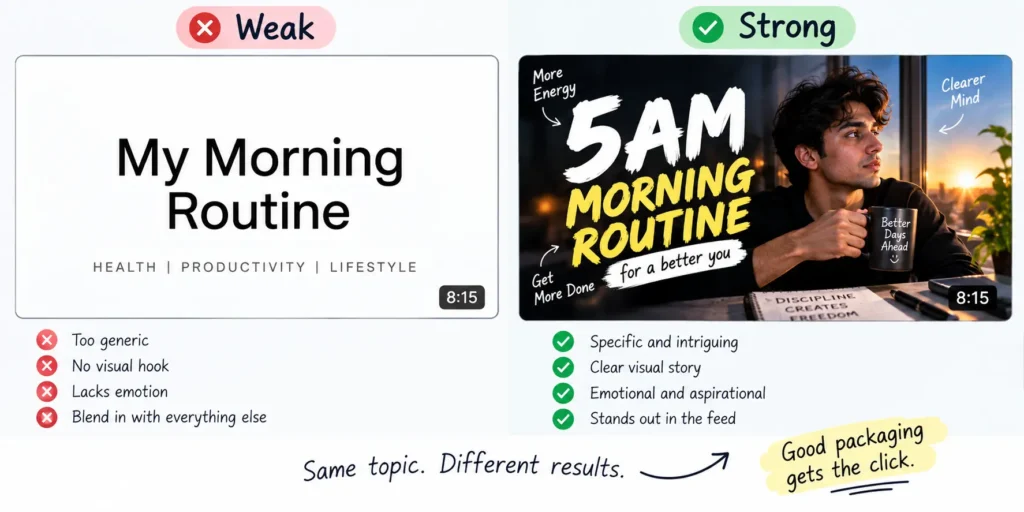
A weak title describes the video. A strong title creates a clear reason to watch it. For example:
- “The Future of AI Agents” describes a subject.
- “One Employee Could Soon Manage 1,000 AI Agents” presents scale, tension, and a consequence.
The second version is more clickable because the viewer immediately understands what is surprising. It does not need dishonest exaggeration. It needs specificity.
The best packaging usually does one of four things: reveals a gap, challenges an assumption, shows a consequence, or promises a useful transformation.
3. Retention
Getting the click is only the beginning. The content must quickly confirm that the promise was worth clicking.
Many videos lose viewers because the creator begins with context that matters to the speaker but not yet to the audience: a long introduction, credentials, greetings, or a slow explanation of how the conversation came together.
Viewers do not owe a creator patience. Patience is earned.
A stronger opening starts close to the tension. It tells viewers what they will learn, why it matters now, or what surprising idea is about to be explained. This is especially important for podcast clips. A clip should not require the audience to understand the entire episode before the moment becomes interesting.
Every sentence at the beginning should make the next sentence easier to watch.
4. Distribution
Publishing is not distribution.
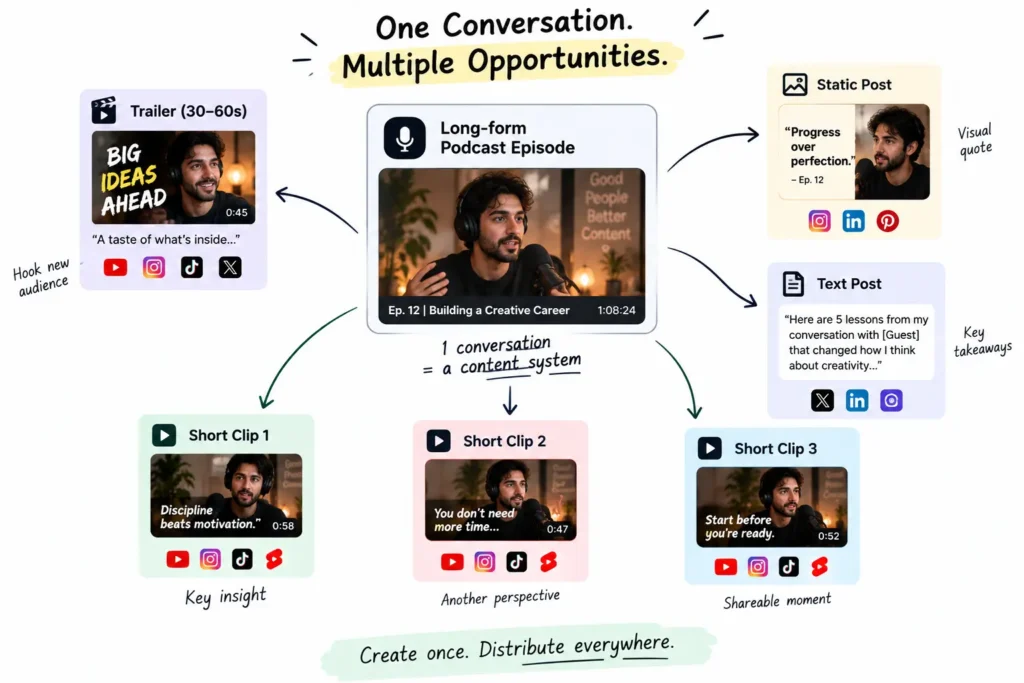
A one-hour podcast uploaded to YouTube is one asset. It is not yet a content system.
The same conversation can produce several entry points: a trailer built around curiosity, short clips based on individual questions, static posts that isolate a strong idea, text posts that add the host’s interpretation, and platform-specific edits with different openings.
This does not mean cutting twenty random clips from every episode. More content is not automatically better distribution. Each asset should have its own reason to exist.
One clip may introduce the guest through a contrarian opinion. Another may solve a narrow problem. A third may make an unfamiliar topic understandable through an analogy. Different entry points allow different segments of the audience to discover the same core conversation.
Boosting Cannot Repair a Weak Content System
When organic reach is low, paid promotion often becomes the immediate response. That can increase impressions, but impressions do not solve weak audience fit, unclear packaging, or poor retention.
Paid media is useful when the objective is defined: reaching a specific audience, generating leads, retargeting interested viewers, testing a message, or scaling content that has already shown strong signals.
It is less useful when it is used to make an underperforming post look successful.
A boost can buy exposure. It cannot make people care.
Before spending, identify the actual constraint:
- If impressions are low but click and watch signals are strong, distribution may be the bottleneck.
- If impressions are healthy but clicks are weak, packaging is the problem.
- If people click but leave quickly, the opening or delivery is failing.
Each problem requires a different fix.
Build a Learning Loop, Not a Posting Calendar
Most teams have a content calendar. Fewer have a content learning system.
A useful review should examine more than total views:
- Which topics attracted new viewers?
- Which titles created clicks without misleading people?
- At what moment did viewers leave?
- Which clips brought people to the long-form episode?
- Which posts generated qualified conversations, not just likes?
- Which formats repeatedly underperformed, and why are we still producing them?
The purpose of analytics is not to admire successful numbers or defend unsuccessful ones. It is to improve the next decision.

The Complete Job
Good content is still the foundation. But quality hidden behind weak packaging, an unfocused opening, or passive distribution rarely gets the chance to prove itself.
Do not ask only whether the content is good.
Ask whether the right person would notice it, choose it, stay with it, and remember it.
That is the complete job.
Key Takeaways
- Good content can still fail – quality is only one layer in a system of four decisions the content must win.
- Views measure consumption, not quality in isolation; a vague title or slow opening can sink a great video.
- The four layers are audience fit, packaging, retention, and distribution – and each needs its own diagnosis.
- Boosting buys exposure, not care – it can’t fix a broken layer, only amplify what’s already working.
- Build a learning loop that tracks where viewers drop off, not just a calendar that tracks what gets posted.